Settlement Amounts in Mass Torts and Class Actions
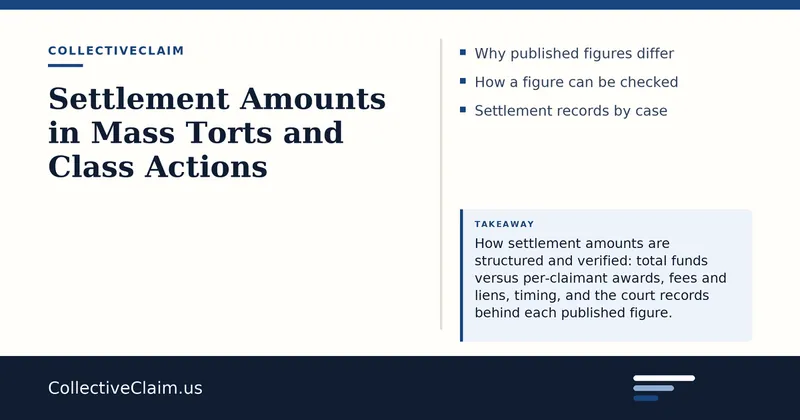
How settlement amounts are structured and verified: total funds versus per-claimant awards, fees and liens, timing.
Advertisement
Advertisement
On this page
A settlement amount is not one number. In a mass tort or a class action the same case can be described by a total fund, a per-claimant average, a range of individual awards, and an amount net of fees and liens — and those figures can differ by an order of magnitude without anyone lying. This page explains how the numbers are built and where each one can be checked, then links the settlement records this publication has documented.
Why published figures differ
The total fund is not what a claimant receives. A settlement is usually a fixed pot, and the pot pays attorneys’ fees, notice and administration costs, and any court-approved service awards before individual claims are paid. A headline “billion-dollar settlement” describes the pot; the money a person sees is what remains after those deductions and after the claims are allocated.
Per-claimant amounts are averages, not entitlements. When a court or administrator reports an average award, it divides a fund by the number of approved claims. Claimants with different injuries, treatment records, or state law can receive very different amounts from the same fund.
Timing changes the number. A settlement announced in one year may be approved, appealed, or partially paid years later. A figure published before final approval is a proposal, not a payment.
Eligibility rules move the denominator. Deadlines, documentation requirements, and whether a case is opt-in or opt-out determine who is counted. A fund divided among fewer approved claims produces a higher average, which is why two reports of the same settlement can disagree.
How a figure can be checked
Every number on this site is meant to be traceable to a document a reader can open: a court order approving a settlement, a settlement administrator’s notice, a trust distribution procedure, or the Judicial Panel on Multidistrict Litigation’s statistics. Where a figure appears in a complaint or a press release rather than a court order, the page says so.
The useful checks are the same in every case: read the approval order for the fund and the fee award, read the plan of allocation for how claims are scored, and read the administrator’s notice for the deadline. An average published without those three documents is context, not a payment amount.
Settlement records by case
The pages below document what the record shows for each case — the fund, the procedural status, and what remains undecided. They are grouped as explainers and as case studies, which follow the same record with the outcome in front.
Cases with settlement records on this site
- AFFF firefighting foam (MDL 2873) — the public water system class settlements, the figures the parties published, and what those funds do not cover.
- Roundup and glyphosate (MDL 2741) — the proposed 2026 nationwide class settlement, the payout range in its own notice programme, and the verdicts before it.
- GLP-1 medicines (MDL 3094) — why the record shows no settlement fund, no claims deadline and no per-claimant amount.
Across all three, the same rule applies: a headline fund is not an individual payment, and an average is not an entitlement.
Case explainers
Case studies
What this page does not do
This page does not estimate what any individual claim is worth, does not collect claim details, and does not pass reader information to law firms. Settlement amounts depend on facts a public record cannot capture: injury, treatment, state law, and the evidence a claimant can produce. A figure that appears here describes a fund or a reported average; it is not an offer, a promise, or legal advice.
CollectiveClaim.us publishes general legal information. This article is not legal advice and does not create an attorney–client relationship. Court records and agency actions change; verify current status with the court or agency before relying on it.
Advertisement
Advertisement