Product Liability
Volkswagen Clean Diesel Litigation: MDL 2672 Status
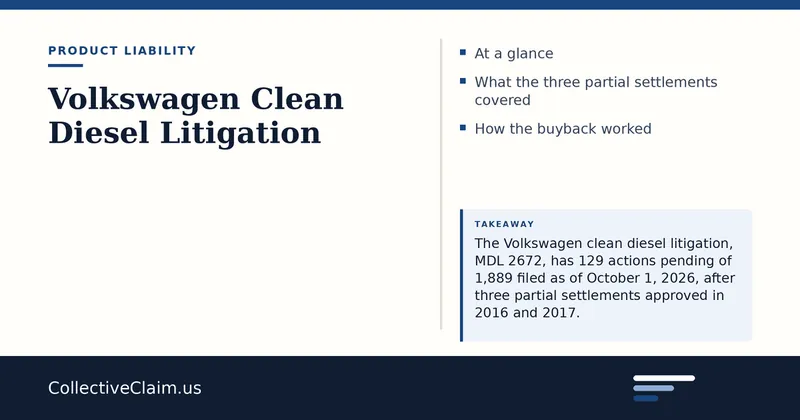
The Volkswagen clean diesel litigation, MDL 2672, had 129 actions pending of 1,889 filed as of October 1, 2026, after partial settlements in 2016 and 2017.
On this page
Something in this article wrong, out of date, or missing its source? Send the editorial desk a note.
The Volkswagen clean diesel litigation is consolidated in MDL No. 2672, In re: Volkswagen “Clean Diesel” Marketing, Sales Practices, and Products Liability Litigation, before Senior U.S. District Judge Charles R. Breyer in the U.S. District Court for the Northern District of California. The Judicial Panel on Multidistrict Litigation (JPML, the federal panel that consolidates related cases) reported 129 actions still pending of 1,889 filed as of October 1, 2026. The case is anchored by three partial settlements with the U.S. Environmental Protection Agency (EPA) approved in 2016 and 2017. Those settlements resolved Clean Air Act allegations rather than a single combined tort recovery.
At a glance
- The JPML statistics report dated October 1, 2026 lists MDL No. 2672 with 129 actions pending and 1,889 total actions historically filed.
- The transferee judge is Senior U.S. District Judge Charles R. Breyer of the Northern District of California, according to the same JPML report.
- The EPA states that the U.S. District Court for the Northern District of California approved the 2.0 liter partial settlement on October 25, 2016.
- The EPA states that the same court approved the 3.0 liter partial settlement on May 17, 2017 and the third partial settlement, covering civil penalties and injunctive relief, on April 13, 2017.
- The EPA states that the settlements resolve allegations involving approximately 590,000 model year 2009 to 2016 diesel vehicles equipped with defeat devices.
What the three partial settlements covered
The EPA describes the resolution as a series of three partial settlements in a civil enforcement case against Volkswagen AG, Audi AG, Dr. Ing. h.c. F. Porsche AG, Volkswagen Group of America, Inc., Volkswagen Group of America Chattanooga Operations, LLC, and Porsche Cars North America, Inc. The United States filed its complaint on January 4, 2016, and amended it on October 7, 2016, alleging Clean Air Act violations for approximately 590,000 diesel vehicles sold in the United States. The EPA alleged that each vehicle contained computer algorithms and calibrations in the engine control module that caused emissions controls to perform differently during normal driving than during emissions testing, and that these were prohibited defeat devices under the Clean Air Act.
The first partial settlement, addressing 2.0 liter diesel vehicles, was approved by the U.S. District Court for the Northern District of California on October 25, 2016. The third partial settlement, addressing civil penalties and injunctive relief, was approved on April 13, 2017. The second partial settlement, addressing 3.0 liter diesel vehicles, was approved on May 17, 2017. Under the third partial settlement, the EPA states that Volkswagen paid a $1.45 billion civil penalty for the alleged civil violations of the Clean Air Act.
How the buyback worked
Under the 2.0 liter partial settlement, the EPA states that Volkswagen was required to remove from commerce in the United States or perform an approved emissions modification on at least 85 percent of the affected 2.0 liter vehicles by June 2019, with a separate 85 percent recall rate in California. To reach that rate, Volkswagen had to offer owners and lessees the opportunity to have their vehicles bought back at a fair replacement value as of September 17, 2015, or to have leases terminated at no cost. The EPA states that the buyback or lease termination option was available to consumers for two years. If Volkswagen fell short of the national recall target, it was required to pay $85 million into the mitigation trust for each percentage point shortfall, and $13.5 million for each percentage point shortfall against the California target.
The 3.0 liter partial settlement set a separate 85 percent requirement for generation 1 vehicles by November 30, 2019, and for generation 2 vehicles by May 31, 2020, with separate California rates and its own shortfall payments. The EPA states that the 2.0 liter partial settlement required Volkswagen to fund a $2.7 billion mitigation trust, and that the 3.0 liter partial settlement added $225 million. The 2.0 liter partial settlement also required $2 billion in zero emission vehicle investment, which the EPA states was implemented through Electrify America, LLC.
What is established vs. what is alleged
The Clean Air Act violations are allegations that the settlements resolved; they were not established through a trial verdict. The EPA page describes the case as resolving allegations that Volkswagen violated the Clean Air Act through the sale of vehicles equipped with defeat devices. The court orders approving the three partial settlements are established facts of record, each tied to a specific approval date.
The EPA states that, under two related settlements approved at the same time, a Federal Trade Commission stipulated order and a class action settlement agreement, Volkswagen agreed to pay eligible consumers compensation for alleged consumer damages related to the marketing and sale of the affected vehicles. The EPA also states that Volkswagen estimated the total cost of achieving the 85 percent recall rate and satisfying the FTC order and class action agreement would be up to $10.033 billion. That figure is an estimate of Volkswagen’s cost across those components as the EPA describes it, not a court-ordered total recovery figure, and this article does not present it as one.
Where the claims stand procedurally
The claims are consolidated in MDL No. 2672 in the U.S. District Court for the Northern District of California before Senior U.S. District Judge Charles R. Breyer as of October 2026. Under the JPML report dated October 1, 2026, 129 actions remain pending out of 1,889 actions filed since the litigation began. The JPML is the federal panel that transfers related cases to one judge for coordinated pretrial proceedings. The same report shows MDL No. 2672 in the group of dockets with between 101 and 999 pending actions.
The source documents do not state a trial date for the remaining docket, and they do not describe any appeal of the settlement approvals. The EPA describes the civil settlements as fully approved by the court, and the JPML continues to count the docket as an active transferred litigation. Readers seeking general background on how consolidated proceedings differ from class actions can review the site’s explainer on MDL versus class action, and those comparing this docket with other large product cases may look at the AFPF firefighting foam litigation, which the same JPML report lists separately.
Key dates
- January 4, 2016: the United States filed its Clean Air Act complaint against the Volkswagen entities.
- October 7, 2016: the United States amended the complaint.
- October 25, 2016: the U.S. District Court for the Northern District of California approved the 2.0 liter partial settlement.
- January 6, 2017: the EPA and the California Air Resources Board approved Volkswagen’s proposed emissions modification for certain 2015 model year 2.0 liter vehicles.
- April 13, 2017: the same court approved the third partial settlement on civil penalties and injunctive relief.
- May 17, 2017: the same court approved the 3.0 liter partial settlement.
- May 19, 2017 and July 27, 2017: the EPA and the California Air Resources Board approved additional 2.0 liter emissions modifications.
- June 2019: the deadline for Volkswagen to remove from commerce or modify at least 85 percent of affected 2.0 liter vehicles.
- November 30, 2019 and May 31, 2020: the recall deadlines for generation 1 and generation 2 3.0 liter vehicles.
- October 1, 2026: the JPML reported 129 actions pending of 1,889 filed in MDL No. 2672.
What this does not establish
The EPA page and the JPML report do not state a single total settlement amount for the litigation as a whole, and this article does not supply one. The $10.033 billion figure is described by the EPA as Volkswagen’s estimate of its cost to meet the recall obligation and satisfy the related FTC order and class action agreement, not as a court-approved total recovery. The source documents do not give per-vehicle payment amounts for any consumer, do not describe the status of individual remaining actions, and do not state whether any of the 129 pending actions have been scheduled for trial. The JPML report supplies counts only and does not describe the substance of the remaining claims. The broader context of how mass tort dockets are organized is covered in the site’s guide to how mass tort litigation works.
Frequently asked questions
What is MDL No. 2672?
MDL No. 2672 is In re: Volkswagen “Clean Diesel” Marketing, Sales Practices, and Products Liability Litigation, consolidated before Senior U.S. District Judge Charles R. Breyer in the U.S. District Court for the Northern District of California. The JPML reported 129 actions pending of 1,889 filed as of October 1, 2026. The docket covers federal claims related to diesel vehicles alleged to contain defeat devices.
Did a court approve the Volkswagen clean diesel settlements?
Yes. The EPA states that the U.S. District Court for the Northern District of California approved the 2.0 liter partial settlement on October 25, 2016, the third partial settlement on April 13, 2017, and the 3.0 liter partial settlement on May 17, 2017. Those approvals are court orders of record. The EPA describes the underlying Clean Air Act violations as allegations that the settlements resolved.
What was the buyback in the Volkswagen clean diesel case?
Under the 2.0 liter partial settlement, the EPA states that Volkswagen had to offer owners and lessees a buyback at fair replacement value as of September 17, 2015, or lease termination at no cost. That option was available for two years. The buyback was one route toward the 85 percent removal or modification requirement that the court order set.
How many actions remain in MDL No. 2672?
The JPML statistics report dated October 1, 2026 lists 129 actions pending and 1,889 total actions historically filed in MDL No. 2672. Those are counts of filed court actions, not individual vehicle owners. The report does not describe the substance or scheduling of the pending actions.
Sources
- United States Judicial Panel on Multidistrict Litigation: “MDL Statistics Report - Distribution of Pending MDL Dockets by Actions Pending” (link, accessed 2026-10-02)
- U.S. Environmental Protection Agency: “Volkswagen Clean Air Act Civil Settlement” (link, accessed 2026-10-02)
- U.S. District Court for the Northern District of California: “Northern District of California | United States District Court” (link, accessed 2026-10-02)
CollectiveClaim.us publishes general legal information. This article is not legal advice and does not create an attorney–client relationship. Court records and agency actions change; verify current status with the court or agency before relying on it.