Product Liability
Bose S1 Pro Battery Pack Recall: What CPSC Recall 27-065 Says
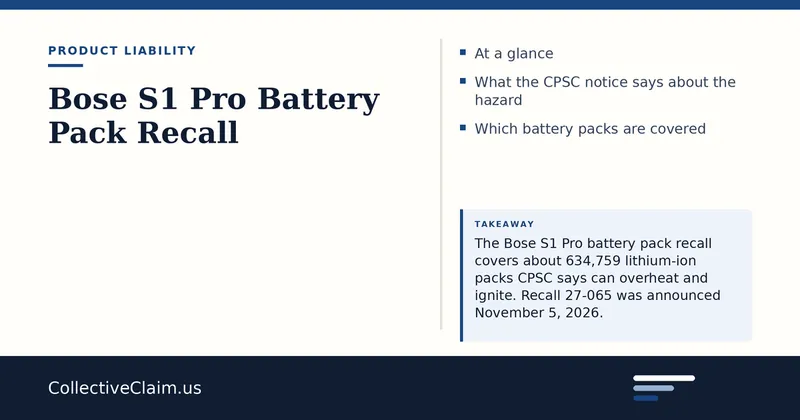
The Bose S1 Pro battery pack recall covers about 634,759 lithium-ion packs CPSC says can overheat and ignite. Recall 27-065 was announced November 5, 2026.
Advertisement
Advertisement
On this page
Something in this article wrong, out of date, or missing its source? Tell the editorial desk.
The Bose S1 Pro battery pack recall covers about 634,759 lithium-ion packs sold with Bose S1 Pro and S1 Pro+ portable Bluetooth speaker systems, plus about 35,400 sold in Canada. The U.S. Consumer Product Safety Commission published the recall, number 27-065, on November 5, 2026. CPSC says the packs can overheat and ignite. The remedy is a free replacement battery pack, and the notice directs owners to remove the recalled packs and stop using them.
At a glance
- Recall 27-065 was announced by the U.S. Consumer Product Safety Commission on November 5, 2026, and covers about 634,759 battery packs in the United States and about 35,400 in Canada.
- The affected units are lithium-ion rechargeable battery packs intended for Bose S1 Pro and S1 Pro+ Portable Bluetooth Speaker Systems.
- CPSC reports seven incidents of packs melting, producing smoke or catching fire, including six reports of property damage. No injuries have been reported.
- The remedy listed in the notice is “Replace,” a free replacement battery pack arranged through Bose.
- Bose Corporation of Framingham, Massachusetts, is the importer, and the battery packs were manufactured in China.
What the CPSC notice says about the hazard
In the recall notice, CPSC states that the recalled lithium-ion battery packs “can overheat and ignite, posing a risk of injury from fire and overheating hazards.” That language is the agency’s hazard description in an administrative recall announcement, and the page carries a Fast Track Recall label. The notice does not describe a failure mechanism or identify a defective component inside the pack.
Which battery packs are covered
The recall covers lithium-ion rechargeable battery packs intended for use with Bose S1 Pro and S1 Pro+ systems. CPSC says the serial number of a recalled pack begins with one of the following prefixes: 083723, 078352, 084105, 078591, 078592, 084106 or 086409. The notice introduces the list as “six digits” and prints seven prefixes.
The 17-digit serial number is printed on a label placed at the bottom of the battery pack. The packs were sold with the speaker systems and also separately as accessories or replacement parts.
CPSC gives the sales period as December 2017 through July 2026. Individual battery packs sold for between $100 and $160, and the speaker systems sold with the battery packs for $700. The products were sold at Bose, Best Buy and other retail stores and distributors nationwide, and online at Amazon.com, Bose.com, BestBuy.com, Walmart.com and other websites.
What the notice tells owners to do
CPSC directs consumers to remove the recalled battery packs from any S1 Pro or S1 Pro+ system and to stop using the packs immediately. Once a pack is removed, the notice says, consumers may continue to use the speaker while it is connected to AC power.
To receive a free replacement, consumers register and provide the affected pack’s serial number at bose.com/support/s1-battery-recall. For packs not installed in a speaker, the notice says consumers can read the serial number and supply it through that site. Bose also lists a toll-free line, 800-278-1083, staffed 9 a.m. to 9 p.m. ET Monday through Friday and 9 a.m. to 7 p.m. ET on Saturday.
Disposal instructions are specific. The packs must not go in the trash, the general recycling stream such as street-level or curbside bins, or used battery recycling boxes at retail and home improvement stores, because recalled lithium-ion batteries carry a greater fire risk than other batteries. A municipal household hazardous waste collection center may accept the pack, and CPSC advises calling that office first to confirm.
What is established vs. what is alleged
Established by the documents: CPSC published recall 27-065 on November 5, 2026; the unit counts, serial prefixes, sales period, prices, retail channels, importer and country of manufacture are as the notice states; the notice records seven incident reports, six involving property damage, and no reported injuries; the remedy is replacement.
Not established: no court has ruled on these battery packs. The recall notice is an administrative announcement rather than a judicial finding of defect, and the incident counts are reports the firm received as summarized by CPSC, not adjudicated claims. The documents contain no admission of liability by Bose Corporation, no damages figure and no compensation program beyond the replacement remedy. Other CPSC actions, such as the Gourmia air fryer oven recall over a burn hazard, follow the same administrative format rather than a court record.
Where the recall stands procedurally
No federal court consolidation appears in the source documents for this recall. There is no MDL (multidistrict litigation, a procedure that gathers federal lawsuits from different districts before one judge for pretrial proceedings), no docket number, no trial date and no appeal. As of November 2026, the action of record is CPSC recall 27-065, announced November 5, 2026, with Bose Corporation as the importing firm.
CPSC states on its About page that federal law prohibits any person from selling products subject to a Commission ordered recall or a voluntary recall undertaken in consultation with the agency, and that a recall usually has no end date even if a consumer learns of it later. The agency also states that each recall applies only to the specific brand and model identified in that announcement. Court-based matters, such as the OneWheel Future Motion litigation, rest on a different record.
Key dates
- December 2017: the start of the sales period CPSC gives for the affected battery packs.
- July 2026: the end of that sales period.
- November 5, 2026: CPSC publishes recall 27-065.
What this does not establish
The record does not show a cause for the reported overheating, a defect rate, or the dates and locations of the seven incidents. It does not show that an injury occurred; it shows that none had been reported when the notice was published. It does not show whether replacement packs differ in design from recalled units, or how quickly replacements arrive. It does not show that other Bose products are affected, and CPSC’s own guidance limits a recall to the brand and model named. It does not explain why the notice calls the serial list “six digits” while printing seven prefixes, and a matching prefix alone does not establish that an individual pack failed. It states no court finding, settlement, verdict or compensation fund.
Frequently asked questions
How can I tell whether my Bose S1 Pro or S1 Pro+ battery pack is recalled?
CPSC recall 27-065 covers Bose S1 Pro and S1 Pro+ battery packs whose 17-digit serial number begins with 083723, 078352, 084105, 078591, 078592, 084106 or 086409. The serial number is printed on a label at the bottom of the pack. The notice lists those prefixes under wording that calls them “six digits.”
What does the Bose battery pack recall provide?
The remedy listed by CPSC is “Replace.” Bose supplies a free replacement battery pack after the consumer registers and provides the affected pack’s serial number at bose.com/support/s1-battery-recall. The consumer line is 800-278-1083, open 9 a.m. to 9 p.m. ET Monday through Friday and 9 a.m. to 7 p.m. ET Saturday.
Can the speaker still be used after the battery pack is removed?
CPSC’s notice says it can. Once the recalled pack is removed, consumers may continue to use the Bose S1 Pro or S1 Pro+ speaker while it is connected to AC power. The notice directs consumers to stop using the battery pack itself immediately.
Have injuries been reported in the Bose S1 Pro battery pack recall?
CPSC reports seven incidents in which the battery packs melted, produced smoke or caught fire, and six of those reports involved property damage. The notice states that no injuries have been reported.
Is there a lawsuit or class action about the Bose S1 Pro battery packs?
No court filing appears in the source documents for this recall. The record described here consists of CPSC recall 27-065, announced November 5, 2026, and CPSC’s general recall and agency pages. Those documents contain no docket number, no MDL, no settlement and no verdict.
Sources
- U.S. Consumer Product Safety Commission: “Bose Recalls Lithium-Ion Battery Packs for S1 Pro and S1 Pro+ Bluetooth Speaker Systems Due to Risk of Injury from Fire and Overheating Hazards” (link, accessed 2026-11-06)
- U.S. Consumer Product Safety Commission: “Recalls & Product Safety Warnings” (link, accessed 2026-11-06)
- U.S. Consumer Product Safety Commission: “About Us” (link, accessed 2026-11-06)
CollectiveClaim.us publishes general legal information. This article is not legal advice and does not create an attorney–client relationship. Court records and agency actions change; verify current status with the court or agency before relying on it.
Advertisement
Advertisement