Environmental Litigation
DOJ Files Motions Defending Rule Rescinding ESA 'Harm' Definition
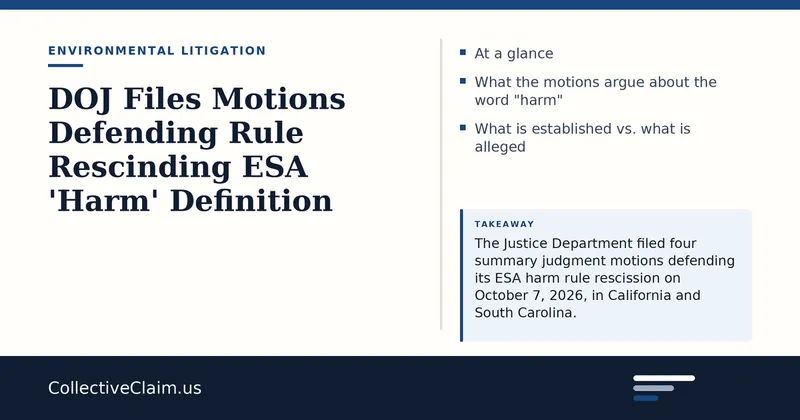
The Justice Department filed four summary judgment motions defending its ESA harm rule rescission on October 7, 2026, in California and South Carolina.
Advertisement
Advertisement
On this page
Something in this article wrong, out of date, or missing its source? Tell the editorial desk.
The U.S. Department of Justice Energy and Natural Resources Division filed four motions for summary judgment on October 7, 2026, defending a rule that rescinds the regulatory definition of “harm” under the Endangered Species Act. The motions respond to challenges in the Northern District of California and the District of South Carolina. The U.S. Fish and Wildlife Service and the National Marine Fisheries Service had issued the rescinded definitions, according to a Justice Department Office of Public Affairs release dated October 8, 2026. The release states that the four cases are the first in a series of similar challenges across the country to reach this stage of litigation.
At a glance
- Four motions for summary judgment were filed on October 7, 2026, and announced on October 8, 2026 in Press Release Number 26-1157.
- The challenges are pending in the U.S. District Court for the Northern District of California and the U.S. District Court for the District of South Carolina.
- The release states that all four cases turn on whether the Endangered Species Act’s restriction on “take” of listed species requires an intentional, purposeful act directed against a particular animal.
- Attorneys from the division’s Wildlife and Marine Resources Section and Natural Resources Section are handling the matters.
- The four cases are described as the first of a series of similar challenges nationwide to reach this stage of litigation.
What the motions argue about the word “harm”
The release summarizes the filings’ account of the statute and its history. It states that Congress defined “take” in the Endangered Species Act to include 10 verbs centered on intentional actions against individual animals, such as hunt, shoot, wound, kill, and trap. It states that the two services interpreted one of those verbs, “harm,” in a way that allowed them to regulate actions that modify a species’ habitat.
According to the release, the Chevron doctrine, which deferred to certain agency interpretations of statutes and which the Supreme Court has since overruled, led to a court decision upholding the prior regulatory definitions of “harm.” A dissent in that decision stated that the statute’s plain language, structure, and history cut against the broad reading. The filings argue that after the Supreme Court’s rejection of Chevron deference in its decision in Loper Bright Enterprises, the services should interpret the statute according to its plain terms, adopt the reasoning of that dissent, and rescind the definitions to return to the statutory text.
Principal Deputy Assistant Attorney General Adam Gustafson of the division said in the release: “Regulatory overreach burdens American families and businesses, and these now-rescinded Endangered Species Act regulations are a prime example.” He added that the Department of Justice “will continue vigorously defending President Trump’s efforts to uphold the Act as written and protect economic growth.”
What is established vs. what is alleged
Established by the record: four motions for summary judgment were filed on October 7, 2026, they are pending in two named district courts, and two named sections of the division are handling them. The release also describes a completed agency action, referring to the Endangered Species Act regulations as “now-rescinded.”
Asserted, not decided: that the statute requires an intentional, purposeful act against a particular animal, that the plain terms of the statute support the rescission, and that the earlier dissent’s reasoning should now control. Those are the department’s litigating positions in pending motions. No court ruling adopting or rejecting them appears in the record.
Where the cases stand procedurally
The four cases are pending in the U.S. District Court for the Northern District of California and the U.S. District Court for the District of South Carolina as of October 8, 2026, the date of the release describing the filings. The release describes four separate cases and does not identify a multidistrict litigation (MDL, a consolidated federal proceeding for related cases) number, a consolidation order, or coordinated pretrial proceedings.
A motion for summary judgment asks a court to decide a case on the written record rather than at trial, and these motions ask the courts to resolve the challenges in favor of the rescission rule. The release gives no hearing date, briefing schedule, or trial date.
The division’s own site describes it as a core litigating component of the Department of Justice and states that its Wildlife and Marine Resources Section handles civil cases under fish and wildlife conservation laws, including the Endangered Species Act. Its news page lists other defense-side matters, including the Clean Water Act Section 404 permit for the Cainhoy Plantation development in Charleston, South Carolina and the Navy’s response to fuel releases at Joint Base Pearl Harbor-Hickam.
Key dates
- October 7, 2026: division attorneys filed the four summary judgment motions, described in the release as filed “yesterday.”
- October 8, 2026: the Justice Department Office of Public Affairs published Press Release Number 26-1157, and the page is marked as updated the same day.
- September 3, 2026: the division’s “Learn More about the Division” page, which describes the Wildlife and Marine Resources Section’s Endangered Species Act work, was last updated.
What this does not establish
- No court order, ruling, or verdict on the four motions appears in the release.
- The release does not name the rescission rule, give its Federal Register citation, or state its effective date.
- Full case names and docket numbers are not provided. The four attachments are labeled NWF v FWS, DW v FWS, CA v Interior, and EPIC v NMFS.
- The earlier decision that upheld the prior “harm” definitions, and the dissent the filings rely on, are not identified by case name, court, or date.
- The record does not show consolidation, an MDL number, a trial date, or an appeal in any of the four cases.
- Nothing in the record creates rights, deadlines, or claims for private parties. The division’s Find Help page states that the Department of Justice is prevented by law from offering legal advice to private citizens.
Frequently asked questions
What did the Justice Department file on October 7, 2026?
The U.S. Department of Justice Energy and Natural Resources Division filed four motions for summary judgment defending a rule that rescinds the regulatory definition of “harm” in U.S. Fish and Wildlife Service and National Marine Fisheries Service regulations under the Endangered Species Act. The Office of Public Affairs announced the filings in a release dated October 8, 2026. The cases are pending in the Northern District of California and the District of South Carolina.
What is the dispute over the word “harm”?
The release states that Congress defined “take” in the Endangered Species Act to include 10 verbs centered on intentional actions against individual animals, such as hunt, shoot, wound, kill, and trap. It states that the Fish and Wildlife Service and the National Marine Fisheries Service read “harm,” one of those verbs, to allow regulation of actions that modify a species’ habitat. The filings argue that “take” requires an intentional, purposeful act directed against a particular animal, and the record shows no court ruling on that argument in these four cases.
Has any court ruled on the four motions?
No court order or ruling on the four motions appears in the Justice Department release of October 8, 2026. The release describes the filings and the department’s arguments, not a decision. It also gives no hearing date, briefing schedule, or trial date.
Does the Justice Department represent private parties in matters like this?
No. The division’s Find Help page states that the Department of Justice represents the United States, its agencies, and Executive Branch personnel, and is prevented by law from offering legal advice to private citizens. The page directs reports of suspected federal wildlife law violations to the regional office of the Fish and Wildlife Service, and marine violations to the National Marine Fisheries Service.
Why does the release describe these cases as the first?
The release states that the four cases in the Northern District of California and the District of South Carolina are the first in a series of similar challenges across the country to reach this stage of litigation. It does not list the other challenges or state how many exist. The summary judgment motions were filed on October 7, 2026.
Sources
- U.S. Department of Justice, Office of Public Affairs: “Justice Department Files Motions Defending a Rule Rescinding the Regulatory Definitions of ‘Harm’ As It Relates to the Endangered Species Act” (link, accessed 2026-11-15)
- U.S. Department of Justice, Energy and Natural Resources Division: “News” (link, accessed 2026-11-15)
- U.S. Department of Justice, Energy and Natural Resources Division: “Learn More about the Division” (link, accessed 2026-11-15)
- U.S. Department of Justice, Energy and Natural Resources Division: “Energy and Natural Resources Division” (link, accessed 2026-11-15)
- U.S. Department of Justice, Energy and Natural Resources Division: “Find Help” (link, accessed 2026-11-15)
CollectiveClaim.us publishes general legal information. This article is not legal advice and does not create an attorney–client relationship. Court records and agency actions change; verify current status with the court or agency before relying on it.
Advertisement
Advertisement