Environmental Litigation
Pearl Harbor Fuel Release: Navy Cleared of Clean Water Act Claims
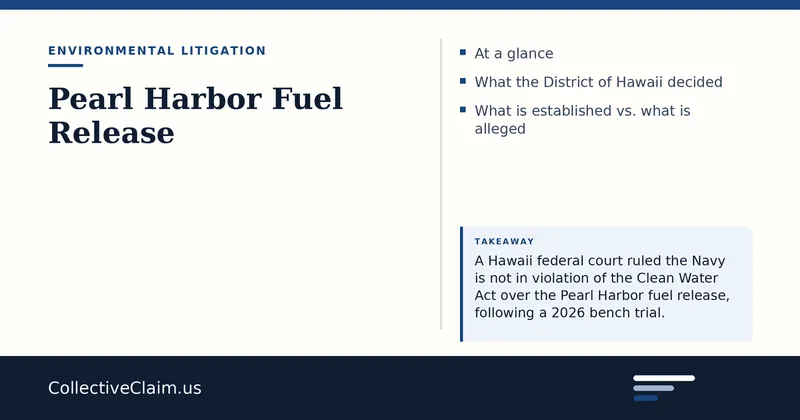
A Hawaii federal court ruled the Navy is not in violation of the Clean Water Act over the Pearl Harbor fuel release, following a 2026 bench trial.
Advertisement
Advertisement
On this page
Something in this article wrong, out of date, or missing its source? Tell the editorial desk.
The U.S. Navy is not in violation of the Clean Water Act at Joint Base Pearl Harbor-Hickam, the U.S. District Court for the District of Hawaii ruled in a decision announced by the Department of Justice on October 30, 2026. The court held that the Navy had shown any Clean Water Act claim was moot, meaning no longer a live dispute for the court to decide, in light of the Navy’s response to fuel releases at the base in 2020 and 2021. The ruling followed a bench trial, a trial decided by a judge rather than a jury, held earlier in 2026. The releases at issue reached Pearl Harbor and Hālawa Stream from two piers at the Joint Base on Oahu, Hawaii.
At a glance
- The U.S. District Court for the District of Hawaii ruled that the U.S. Navy is not in violation of the Clean Water Act at Joint Base Pearl Harbor-Hickam, according to a Department of Justice press release dated October 30, 2026.
- The court held that any Clean Water Act claim was moot given the Navy’s response to fuel releases in 2020 and 2021 from two piers at the Joint Base.
- The decision followed a bench trial held earlier in 2026.
- Attorneys from the Environmental Defense Section of the Department of Justice’s Energy and Natural Resources Division handled the litigation.
- The release quotes Principal Deputy Assistant Attorney General Adam Gustafson of the Energy and Natural Resources Division welcoming the decision.
What the District of Hawaii decided
The Department of Justice described the ruling as resting on the court’s review of the Navy’s response to the 2020 and 2021 releases and of “other substantial improvements the Navy has made in the fueling infrastructure and operations.” According to the release, the Navy identified the source of the releases and stopped them, made substantial repairs to the fueling infrastructure at the facility, and improved fueling operations.
After considering the testimony and evidence offered at trial, the court held that the Navy demonstrated that any claim regarding Clean Water Act violations was moot in light of that response. The release quotes the court as stating that “there is no reasonable likelihood that the Navy will release fuel from the Facility into [Pearl Harbor] or Hālawa Stream,” and that “it is absolutely clear” that any violations of the Clean Water Act cannot “reasonably be expected to occur.”
Adam Gustafson, identified in the release as Principal Deputy Assistant Attorney General of the Energy and Natural Resources Division (ENRD), said the department was pleased the court “carefully and thoroughly reviewed the Navy’s comprehensive response to the release of fuel into Pearl Harbor years ago,” and that the decision affirms the Navy “has taken action to protect human health and the environment consistent with both the law and the United States’ appreciation for the waters of Hawaii.”
What is established vs. what is alleged
The ruling is a court decision from the U.S. District Court for the District of Hawaii, announced by the Department of Justice in Press Release Number 26-1296 on October 30, 2026. The release states that the court ruled the Navy is not in violation of the Clean Water Act and that the court held any such claim moot.
The claims themselves were allegations brought against the Navy before trial: assertions that its operations at Joint Base Pearl Harbor-Hickam violated the Clean Water Act. The release does not identify the parties that brought those claims, and it does not reproduce the complaint or describe the relief sought.
The factual assertions about the Navy’s conduct come from the Department of Justice, which defended the case and describes the Navy’s repairs and operational changes in its own press release. The release does not attach the underlying court filing, so the quoted language from the court appears only as excerpted by the department.
Where the Pearl Harbor fuel release claims stand procedurally
The matter was decided in a single federal trial court, not through consolidated pretrial proceedings. The release identifies no multidistrict litigation number, and it gives no docket number or case name for the case in the District of Hawaii. For background on how consolidated federal pretrial proceedings differ from a single case, see how multidistrict litigation differs from a class action.
The sequence described in the release is: fuel releases from two piers in 2020 and 2021, a bench trial earlier in 2026, and a ruling issued in the week before the October 30, 2026 announcement. The release does not state whether a notice of appeal has been filed or whether the time to appeal has run.
The Department of Justice’s ENRD is described on the division’s own pages as a core litigating component that brings cases under environmental statutes and defends the federal government in litigation arising under those statutes. The Environmental Defense Section, which handled this case, is one of the division’s ten listed practice areas. Comparable Clean Water Act defense work by the same section is described in the Army Corps Section 404 permit ruling, and related contamination litigation is covered in AFFF and PFAS firefighting foam litigation.
Key dates
- 2020 and 2021: fuel releases to Pearl Harbor and Hālawa Stream from two piers at Joint Base Pearl Harbor-Hickam, per the Department of Justice.
- 2026, earlier in the year: a bench trial was held on claims that the Navy violated the Clean Water Act at the Joint Base.
- Week of October 30, 2026: the U.S. District Court for the District of Hawaii issued the ruling, which the release describes as coming “earlier this week.”
- October 30, 2026: the Department of Justice published Press Release Number 26-1296 announcing the ruling.
- September 3, 2026: the ENRD “Learn More about the Division” page carrying the division’s structure and mission was last updated.
What this does not establish
The release does not name the plaintiffs, the presiding judge, a docket number, or a case caption. It does not state whether the ruling has been entered as a written judgment, and it says nothing about any appeal.
It gives no volume or composition of the fuel released, does not name the two piers, and does not quantify any repair cost, civil penalty, or remediation spending. It does not describe injuries or medical claims, and it does not address any statute other than the Clean Water Act.
The release also does not set out the court’s full reasoning on mootness, and it does not state whether the court made any factual finding that a violation occurred before the response. Nothing in the document establishes rights or outcomes for any other person, facility, or release.
Frequently asked questions
Did the court find the Navy violated the Clean Water Act at Joint Base Pearl Harbor-Hickam?
No. The Department of Justice announced on October 30, 2026 that the U.S. District Court for the District of Hawaii ruled the U.S. Navy is not in violation of the Clean Water Act at Joint Base Pearl Harbor-Hickam. The court held that any claim of violation was moot in light of the Navy’s response to the 2020 and 2021 fuel releases.
What happened during the 2020 and 2021 fuel releases at Joint Base Pearl Harbor-Hickam?
According to the Department of Justice, fuel was released to Pearl Harbor and Hālawa Stream from two piers at Joint Base Pearl Harbor-Hickam in 2020 and 2021. The release states that the Navy identified the source of the releases and stopped them, then repaired the fueling infrastructure and improved fueling operations. The release does not state how much fuel was released.
Was the Pearl Harbor fuel release case decided by a jury?
No. The Department of Justice states that the ruling followed a bench trial, in which a judge rather than a jury decides the facts, held earlier in 2026 in the U.S. District Court for the District of Hawaii. The court then held that any Clean Water Act claim was moot.
Which part of the Department of Justice handled the defense?
The Environmental Defense Section of the Department of Justice’s Energy and Natural Resources Division handled the litigation, according to the October 30, 2026 release. The division describes itself as a core litigating component that enforces environmental laws and defends federal agencies in litigation under those laws.
Can the Energy and Natural Resources Division give legal advice to a private individual?
No. The division’s own guidance states that the Department of Justice is prevented by law from offering legal advice to private citizens. The same page says the division does not typically investigate alleged violations of federal environmental laws until a federal agency, such as the Environmental Protection Agency, refers a matter to it.
Sources
- U.S. Department of Justice, Office of Public Affairs: “Justice Department Defends the Navy’s Actions to Address a Fuel Release at Joint Base Pearl Harbor-Hickam in Hawaii” (link, accessed 2026-11-12)
- U.S. Department of Justice, Energy and Natural Resources Division: “Learn More about the Division” (link, accessed 2026-11-12)
- U.S. Department of Justice, Energy and Natural Resources Division: “Energy and Natural Resources Division” (link, accessed 2026-11-12)
- U.S. Department of Justice, Energy and Natural Resources Division: “Find Help” (link, accessed 2026-11-12)
CollectiveClaim.us publishes general legal information. This article is not legal advice and does not create an attorney–client relationship. Court records and agency actions change; verify current status with the court or agency before relying on it.
Advertisement
Advertisement