Environmental Litigation
Fourth Circuit Affirms Cainhoy Plantation Clean Water Act Permit
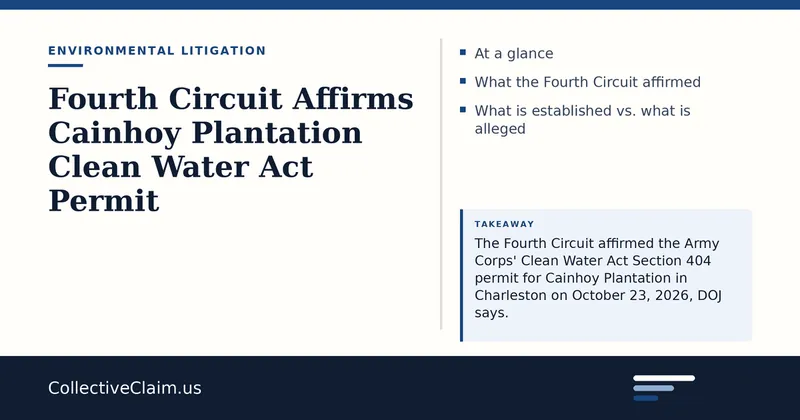
The Fourth Circuit affirmed the Army Corps' Clean Water Act Section 404 permit for Cainhoy Plantation in Charleston on October 23, 2026, DOJ says.
Advertisement
Advertisement
On this page
Something in this article wrong, out of date, or missing its source? Tell the editorial desk.
The U.S. Court of Appeals for the Fourth Circuit affirmed on October 23, 2026 the U.S. Army Corps of Engineers’ Clean Water Act Section 404 permit for the Cainhoy Plantation development in Charleston, South Carolina. The U.S. Department of Justice announced the appellate ruling in Press Release Number 26-1257. According to the release, the decision clears the way for a long-term housing initiative on portions of a 9,076-acre property. Attorneys from four sections of the Department’s Energy and Natural Resources Division (ENRD, the component that defends federal agencies in environmental litigation) handled the appeal.
At a glance
- The ruling is an affirmance by the U.S. Court of Appeals for the Fourth Circuit issued October 23, 2026, as described in Department of Justice Press Release Number 26-1257.
- The authorization at issue is a Clean Water Act Section 404 permit issued by the U.S. Army Corps of Engineers for the Cainhoy Plantation development in Charleston, South Carolina.
- The release states that the permit covers residential and mixed-use development on portions of a 9,076-acre property.
- The release states that projected wetlands impacts were reduced by nearly 90%, from 1,820 acres to 181.5 acres.
- Four ENRD sections handled the litigation: Environmental Defense, Natural Resources, Wildlife and Marine Resources, and Appellate.
What the Fourth Circuit affirmed
The decision is a ruling by the federal appellate court, dated October 23, 2026, affirming the Corps’ issuance of a Clean Water Act Section 404 permit. Section 404 is the Clean Water Act provision under which the Corps issued the permit; the release does not set out the statutory criteria the Corps applied.
According to the release, the permit authorizes residential and mixed-use development on portions of a 9,076-acre property that the City of Charleston has long identified as essential to meeting regional growth and housing demand. The release states that the project will provide new housing, schools, medical facilities, and community services, and that thousands of acres will be permanently conserved.
The release attributes two findings to the court. First, that the Corps conducted a thorough, data-driven review of numerous alternatives before concluding that none offered a practicable path to delivering needed housing with fewer environmental impacts. Second, that the Corps worked with the developers to reduce projected wetlands impacts by nearly 90%, from 1,820 acres to 181.5 acres, after years of analysis and refinement.
“Charleston’s rapid growth has created a real need for responsibly planned housing,” said Principal Deputy Assistant Attorney General Adam Gustafson of ENRD, in the release. “This ruling confirms that the Corps followed the law, thoroughly evaluated alternatives, and approved a plan that supplies homes and community infrastructure while protecting the region’s most valuable wetlands.”
What is established vs. what is alleged
What is established in this record is the court action itself: the U.S. Court of Appeals for the Fourth Circuit affirmed the permit on October 23, 2026, and the Department of Justice published its account the same day. The acreage figures and the description of the alternatives review come from that Department account.
What is not in the record is any allegation by a party. The release does not name the challengers, does not summarize their arguments, and does not describe the ruling of the court below. The release likewise reports no dissent and quotes no part of the opinion.
The release reflects the Department’s characterization of the decision. The opinion text, the administrative record, and the briefs are not among the materials available here, so the court’s reasoning is reported as the Department described it.
Where the Cainhoy Plantation permit challenge stands procedurally
This is a single appellate challenge to a federal permit, not a consolidated proceeding. No multidistrict litigation (MDL, a consolidation of related federal lawsuits before one judge for pretrial proceedings) appears in these documents. The release gives no docket number for the Fourth Circuit appeal and does not identify the district court decision that was under review.
The Department’s Energy and Natural Resources Division news index lists the Cainhoy Plantation item under October 23, 2026, alongside releases on other environmental matters. The release does not state whether any party has sought or could seek further review.
Who handled the appeal at the Justice Department
Attorneys from four ENRD sections handled the litigation, according to the release: the Environmental Defense Section, the Natural Resources Section, the Wildlife and Marine Resources Section, and the Appellate Section. The Division’s own description of its work states that it represents federal agencies including the Army Corps of Engineers, and that the Appellate Section handles initial appeals of cases litigated by Division attorneys. The Division describes itself as a core litigating component of the Department of Justice with 9 litigating sections and 612 employees.
Key dates
- October 23, 2026: The U.S. Court of Appeals for the Fourth Circuit affirmed the Clean Water Act Section 404 permit for Cainhoy Plantation, and the Department of Justice issued Press Release Number 26-1257 describing the decision.
- October 23, 2026: The ENRD news index published the same release under this date.
- September 3, 2026: The ENRD “Learn More about the Division” page supplied with this article was last updated.
- November 5, 2026: The ENRD “Find Help” page supplied with this article was last updated.
What this does not establish
The materials here do not establish the identity of the challengers, the contents of their claims, or the reasoning of the district court. They do not contain the appellate opinion, a docket number, or a citation.
They do not establish an independent measurement of wetlands impacts beyond the figures the Department attributes to the Corps and the court. They give no construction schedule, no start date, and no statement of how many homes the project will contain.
They do not create any right or entitlement for a reader, and they do not describe how any individual matter would be handled. The Division’s own “Find Help” page states that the Department of Justice is prevented by law from offering legal advice to private citizens, and directs anyone suspecting a wetlands violation to contact the U.S. Army Corps of Engineers district for the region and the Environmental Protection Agency regional office.
Frequently asked questions
What did the Fourth Circuit decide about the Cainhoy Plantation permit?
The U.S. Court of Appeals for the Fourth Circuit affirmed the U.S. Army Corps of Engineers’ Clean Water Act Section 404 permit for the Cainhoy Plantation development in Charleston, South Carolina, in a decision dated October 23, 2026. The U.S. Department of Justice described the ruling in Press Release Number 26-1257. The release does not include the opinion text or a docket number.
How large is the Cainhoy Plantation property and how much wetland is affected?
According to Department of Justice Press Release Number 26-1257, the permit covers residential and mixed-use development on portions of a 9,076-acre property in Charleston, South Carolina. The release states that projected wetlands impacts fell from 1,820 acres to 181.5 acres, a reduction of nearly 90%. Those figures come from the Department’s account of the ruling.
Which parts of the Justice Department handled the Cainhoy Plantation appeal?
The release states that attorneys from four sections of the Energy and Natural Resources Division handled the litigation: Environmental Defense, Natural Resources, Wildlife and Marine Resources, and Appellate. The Division describes itself as the component that defends federal agencies, including the U.S. Army Corps of Engineers, in environmental litigation. Its Appellate Section handles initial appeals of cases litigated by Division attorneys.
Is the Cainhoy Plantation permit part of a multidistrict litigation?
No. The documents supplied here describe a single appellate challenge to a Clean Water Act Section 404 permit issued by the U.S. Army Corps of Engineers, and they contain no reference to a multidistrict litigation, which is a consolidation of related federal cases before one judge for pretrial proceedings. The release also does not state whether further review has been sought.
Can the Justice Department advise someone who objects to a wetlands permit?
No. The Energy and Natural Resources Division’s “Find Help” page states that the Department of Justice is prevented by law from offering legal advice to private citizens. That page directs anyone who suspects a wetlands violation to contact the U.S. Army Corps of Engineers district for the region and the Environmental Protection Agency regional office. Related environmental litigation coverage appears in the site’s page on AFFF and PFAS firefighting foam litigation, and the differences between case structures are explained in MDL vs. class action.
Sources
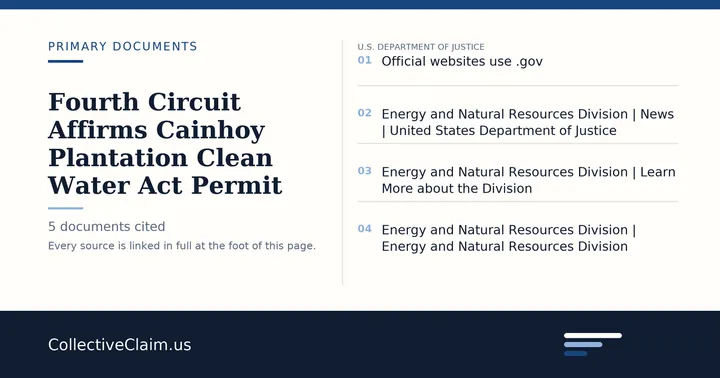
- U.S. Department of Justice, Office of Public Affairs: “Justice Department Defends Army Corps’ Thorough Review for CWA Permit, Paving the Way for Much Needed Housing Development in Charleston, South Carolina” (link, accessed 2026-11-12)
- U.S. Department of Justice, Energy and Natural Resources Division: “News” (link, accessed 2026-11-12)
- U.S. Department of Justice, Energy and Natural Resources Division: “Learn More about the Division” (link, accessed 2026-11-12)
- U.S. Department of Justice, Energy and Natural Resources Division: “Energy and Natural Resources Division” (link, accessed 2026-11-12)
- U.S. Department of Justice, Energy and Natural Resources Division: “Find Help” (link, accessed 2026-11-12)
CollectiveClaim.us publishes general legal information. This article is not legal advice and does not create an attorney–client relationship. Court records and agency actions change; verify current status with the court or agency before relying on it.
Advertisement
Advertisement