Environmental Litigation
California Couple Sentenced for Trafficking Protected Wildlife
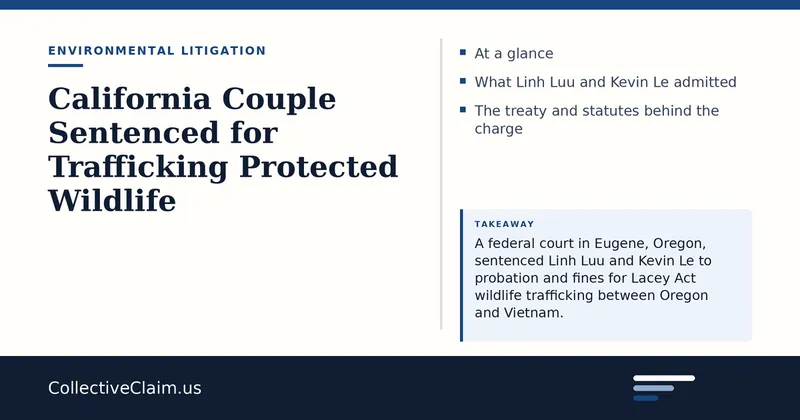
A federal court in Eugene, Oregon, sentenced Linh Luu and Kevin Le to probation and fines for Lacey Act wildlife trafficking between Oregon and Vietnam.
Advertisement
Advertisement
On this page
Something in this article wrong, out of date, or missing its source? Tell the editorial desk.
Linh Luu and Kevin Le, a husband and wife from Anaheim, California, were sentenced on October 23, 2026, in the U.S. District Court for the District of Oregon to three years’ probation and a $10,000 fine each. Both pleaded guilty that day to violating the Lacey Act, the country’s oldest wildlife trafficking statute. The U.S. Department of Justice announced the plea and sentence in Press Release No. 26-1254 from its Office of Public Affairs, which describes trafficking of protected wildlife between Oregon and Vietnam.
At a glance
- Linh Luu and Kevin Le each received three years’ probation and a $10,000 fine in the U.S. District Court for the District of Oregon on October 23, 2026.
- Both pleaded guilty that day to violating the Lacey Act for roles in moving wildlife between Oregon and Vietnam.
- According to the Justice Department, the couple processed $51,100 in payments from September 2019 through May 2021 to aid an individual in Vietnam in illegally moving wildlife items to and from Oregon.
- The parts listed were American black bear gallbladders, cougar bones, lion teeth, black and white rhinoceros horn segments, and a tiger pelt.
- The U.S. Fish and Wildlife Service Office of Law Enforcement investigated, with assistance from Homeland Security Investigations and the Oregon State Police.
What Linh Luu and Kevin Le admitted
According to court documents and statements made in court, the couple admitted that from September 2019 through May 2021 they processed $51,100 in payments to aid an individual in Vietnam in illegally moving wildlife items to and from Oregon. The parts shipped to Vietnam were American black bear gallbladders and cougar bones. The parts imported to Oregon were lion teeth, segments from black and white rhinoceros horns, and a tiger pelt.
A sentencing submission filed by the government describes a December 2020 meeting in a parking lot with an undercover federal agent. The couple accepted $12,000 in cash as a down payment for part of a rhino horn and discussed ways to avoid U.S. banking regulations that could detect illicit transactions. Each later received nearly $5,000 in electronic payments for the horn segment, which was shipped to Oregon disguised as a household decoration. The release states the sale was discussed as a way to build trust for future, larger deals.
The treaty and statutes behind the charge
All of the wildlife whose parts were trafficked in the case is listed under the Convention on International Trade in Endangered Species of Wild Fauna and Flora (CITES), a treaty the United States, Vietnam, and 183 other governments have signed to regulate commercial trade in species that are or may become extinct. Trade in listed species is prohibited without a permit, and the release states the defendants did not receive one.
American black bears and cougars are native to Oregon and are prized by some for use in traditional Asian medicine, according to the release. Lions, tigers, and black and white rhinoceroses are also protected under the Endangered Species Act. The Lacey Act prohibits, among other things, buying or selling wildlife that was illegally imported or exported. The Justice Department’s Energy and Natural Resources Division (ENRD) describes its Environmental Crimes Section as bringing criminal prosecutions against people found smuggling wildlife and plants into the United States, work related to the division’s separate defense of a rule rescinding the regulatory definition of “harm” under the Endangered Species Act, which is tracked in that ENRD filing article.
Senior Trial Attorney Ryan Connors of ENRD’s Environmental Crimes Section and Assistant U.S. Attorney William McLaren for the District of Oregon prosecuted the case. The announcement was made by Principal Deputy Assistant Attorney General Adam Gustafson of ENRD, U.S. Attorney Scott E. Bradford for the District of Oregon, and Assistant Director Douglas Ault of the U.S. Fish and Wildlife Service.
What is established vs. what is alleged
A guilty plea is the defendant’s own admission, so the core conduct here is admitted rather than merely alleged, and the sentence was imposed by the court on October 23, 2026. Established by the record: the pleas, the three years’ probation and $10,000 fine for each defendant, the court, the case number, and the list of wildlife parts.
Attributed to a prosecutor’s filing: the account of the December 2020 undercover meeting, the $12,000 cash down payment, and the discussion of bank reporting rules appears in a sentencing submission filed by the government, which is one party’s filing. The release reports those details without stating that the defendants contested them.
Resolved without a trial: the case ended in guilty pleas and sentencing, not in a jury verdict, so no court has weighed the evidence at trial.
Where the case stands procedurally
This is not a consolidated civil proceeding. There is no multidistrict litigation (MDL, a procedure that gathers related civil suits before one judge for coordinated pretrial proceedings) and no class action. The matter is a single federal criminal case, No. 26-cr-00297, in the U.S. District Court for the District of Oregon, heard in federal court in Eugene, Oregon.
The case is a single criminal matter, No. 26-cr-00297, in the U.S. District Court for the District of Oregon, with plea and sentencing on October 23, 2026, as of the Justice Department release published that day. The release describes no appeal, no post-sentencing motion, and no conditions of probation.
Related enforcement coverage from the same division includes four individuals pleading guilty to a monkey video conspiracy, announced the same day as this sentence.
Key dates
- September 2019: start of the period in which, per the Justice Department, the couple processed $51,100 in payments tied to illegal wildlife shipments.
- December 2020: meeting with an undercover federal agent in a parking lot, where $12,000 in cash was accepted as a down payment for part of a rhino horn, according to the government’s sentencing submission.
- May 2021: end of the payment period described in the release.
- October 23, 2026: guilty pleas and sentencing in federal court in Eugene, Oregon, and publication of Justice Department Press Release No. 26-1254.
What this does not establish
- The release reports no appeal, so no appellate outcome exists in the record described.
- It states no restitution, forfeiture, or penalty beyond three years’ probation and a $10,000 fine for each defendant.
- It does not identify, charge, or describe the outcome for the individual in Vietnam who received the payments.
- It does not say how the investigation began or what became of any other participants.
- It establishes no civil liability for any party, and no civil case is described.
- It gives no market value for the wildlife parts beyond the payment and down payment figures quoted.
Frequently asked questions
Who was sentenced in the Lacey Act wildlife trafficking case?
Linh Luu and Kevin Le, a husband and wife from Anaheim, California, were sentenced on October 23, 2026, in the U.S. District Court for the District of Oregon. Each received three years’ probation and a $10,000 fine. Both had pleaded guilty that day to violating the Lacey Act.
Which wildlife parts were trafficked?
The Justice Department listed American black bear gallbladders and cougar bones shipped to Vietnam, and lion teeth, black and white rhinoceros horn segments, and a tiger pelt imported to Oregon. All of the species involved are listed under the Convention on International Trade in Endangered Species of Wild Fauna and Flora. The release states that trade in listed species requires a permit and that Linh Luu and Kevin Le did not receive one.
What does the Lacey Act prohibit?
The Lacey Act is the oldest wildlife trafficking statute in the United States and prohibits, among other things, buying or selling wildlife that was illegally imported or exported. Linh Luu and Kevin Le pleaded guilty to violating it. Prosecutors were Senior Trial Attorney Ryan Connors of the Justice Department’s Environmental Crimes Section and Assistant U.S. Attorney William McLaren for the District of Oregon.
Is there a claims process or compensation fund connected to this case?
The Justice Department release describes a criminal sentence of probation and fines and mentions no claims process or compensation fund. The Energy and Natural Resources Division states on its Find Help page that the Department of Justice is prevented by law from offering legal advice to private citizens. That page directs anyone who suspects a federal wildlife law violation to the U.S. Fish and Wildlife Service office for their region.
Sources
- U.S. Department of Justice, Office of Public Affairs: “California Couple Sentenced for Trafficking Protected Wildlife” (link, accessed 2026-11-12)
- U.S. Department of Justice, Energy and Natural Resources Division: “News” (link, accessed 2026-11-12)
- U.S. Department of Justice, Energy and Natural Resources Division: “Learn More about the Division” (link, accessed 2026-11-12)
- U.S. Department of Justice, Energy and Natural Resources Division: “Energy and Natural Resources Division” (link, accessed 2026-11-12)
- U.S. Department of Justice, Energy and Natural Resources Division: “Find Help” (link, accessed 2026-11-12)
CollectiveClaim.us publishes general legal information. This article is not legal advice and does not create an attorney–client relationship. Court records and agency actions change; verify current status with the court or agency before relying on it.
Advertisement
Advertisement