Class Actions
Civil Litigation Law Firm Query: SEC Release 26636 Court Order
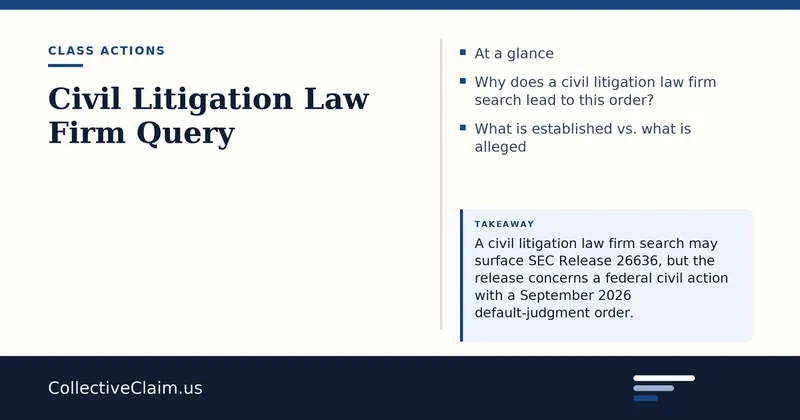
A civil litigation law firm search may surface SEC Release 26636, but the release concerns a federal civil action with a September 2026 default-judgment order.
Advertisement
Advertisement
On this page
Something in this article wrong, out of date, or missing its source? Tell the editorial desk.
The U.S. Securities and Exchange Commission (SEC) lists Litigation Release No. LR-26636 as a federal civil action, not an administrative proceeding or a civil litigation law firm. The PDF is a filed order granting default judgment against Invesco Alpha Inc. The United States District Court for the District of Colorado issued the order on September 9, 2026, in Civil Action No. 25-cv-03651-NYW-KAS.
At a glance
- The SEC lists Invesco Alpha Inc. under Litigation Release No. LR-26636, dated September 11, 2026.
- The linked PDF is Document 14, filed September 9, 2026, in the United States District Court for the District of Colorado.
- The court granted the SEC’s motion for default judgment and directed the clerk to enter judgment.
- The order imposes permanent injunctions and a $1,182,254 civil penalty payable to the SEC.
Why does a civil litigation law firm search lead to this order?
The SEC’s litigation-release page lists civil actions brought by the agency in federal court. Its entry for Invesco Alpha Inc. identifies an “Order Granting Motion for Default Judgment” and a separate “Final Judgment” link. The supplied PDF is the order, not the separately listed final-judgment document.
The SEC distinguishes its federal-court litigation releases from administrative proceedings, which involve orders and opinions issued by the Commission. Here, the PDF bears a federal district court caption, a civil action number, a document number and a filing date. It names the SEC as plaintiff and Invesco Alpha Inc. as defendant. It does not identify a civil litigation law firm as a party or describe a law-firm service. For broader context on court processes, see civil litigation procedures.
What is established vs. what is alleged
The September 9, 2026 court order says Magistrate Judge Kathryn A. Starnella recommended granting the SEC’s application for default judgment on August 25, 2026. No party objected within the period stated in the recommendation. District Judge Nina Y. Wang reviewed the recommendation for clear error on the face of the record, adopted it and granted the SEC’s motion. A default judgment is a judgment entered without a contested trial of the claims.
The court found that it had jurisdiction under the Investment Advisers Act of 1940. It also found that Invesco Alpha Inc. used interstate-commerce means or the mails to engage in conduct alleged in the complaint. The order does not reproduce the complaint or present findings from a contested trial of every allegation.
The court permanently enjoined Invesco Alpha Inc. from failing to make its books and records available to the SEC under Section 204(a) of the Advisers Act. It also enjoined violations of Section 207 involving materially untrue statements or omissions in reports filed with the SEC. A permanent injunction is a court order restricting specified conduct without a stated end date. The order additionally bars Invesco Alpha Inc., its owners and its executive officers from filing Form ADV as an Exempt Reporting Adviser. The order specifies how its injunctions can bind others who receive actual notice.
The court ordered Invesco Alpha Inc. to pay a $1,182,254 civil penalty to the SEC within 30 days after entry of final judgment. It directed the SEC to send penalty funds paid under the judgment to the United States Treasury. The order addresses post-judgment interest on amounts due after that 30-day period and retains jurisdiction to enforce the judgment. It states that the SEC is entitled to its costs.
For bankruptcy-discharge exceptions only, the order treats the complaint’s allegations as true and characterizes debts arising from this proceeding under the cited bankruptcy provision. That limited provision should not be read as a contested-trial finding.
Where does the federal case stand?
Civil Action No. 25-cv-03651-NYW-KAS was before the United States District Court for the District of Colorado as of September 9, 2026. The court directed the clerk to enter default judgment and terminate the case. The supplied order does not provide a trial date or an appeal status. It identifies a single civil action, not a consolidated multidistrict case or a class action. The SEC’s enforcement overview explains that the agency can litigate cases in federal court or pursue administrative proceedings; this record documents the federal-court route. See also civil litigation for a separate overview of the subject.
Key dates
- August 25, 2026: Magistrate Judge Kathryn A. Starnella issued and served the recommendation to grant the SEC’s default-judgment motion.
- September 9, 2026: District Judge Nina Y. Wang adopted the recommendation and granted the motion in an order filed as Document 14.
- September 11, 2026: The SEC listed Invesco Alpha Inc. under Litigation Release No. LR-26636.
What this does not establish
The supplied documents do not establish that this was an SEC administrative proceeding, a class action, a settlement or a jury verdict. The filed PDF does not establish that a civil litigation law firm represents a reader or has any role in the case. Although the SEC separately lists a final judgment, that document’s text was not supplied here. The order directs a penalty payment to the SEC and then the Treasury; it does not establish a distribution to investors. A supplied SEC search-results page for “class action” contains other filings, but does not identify this case as a class action.
Frequently asked questions
Is SEC Litigation Release No. LR-26636 an administrative proceeding?
The U.S. Securities and Exchange Commission lists Litigation Release No. LR-26636 among its federal-court civil actions. The linked order was filed in the United States District Court for the District of Colorado.
What kind of document is the PDF for Release No. LR-26636?
The PDF for U.S. Securities and Exchange Commission Litigation Release No. LR-26636 is a filed court order. The United States District Court for the District of Colorado granted a default-judgment motion in that order on September 9, 2026.
Did the order establish an investor payout?
The United States District Court for the District of Colorado ordered Invesco Alpha Inc. to pay a $1,182,254 civil penalty to the U.S. Securities and Exchange Commission on September 9, 2026. The order directs the agency to send funds paid under the judgment to the United States Treasury. It does not specify an investor payout.
Sources
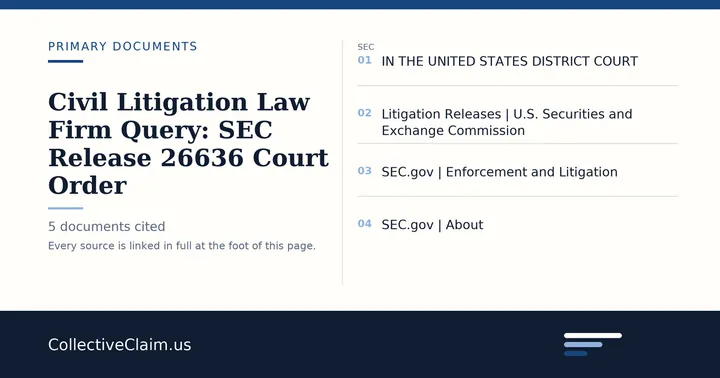
- United States District Court for the District of Colorado: “Order Adopting Magistrate Judge’s Recommendation and Granting Motion for Default Judgment” (link, accessed 2026-11-12)
- U.S. Securities and Exchange Commission: “Litigation Releases” (link, accessed 2026-11-12)
- U.S. Securities and Exchange Commission: “Enforcement and Litigation” (link, accessed 2026-11-12)
- U.S. Securities and Exchange Commission: “About” (link, accessed 2026-11-12)
- U.S. Securities and Exchange Commission: “Search results for ‘class action’” (link, accessed 2026-11-12)
CollectiveClaim.us publishes general legal information. This article is not legal advice and does not create an attorney–client relationship. Court records and agency actions change; verify current status with the court or agency before relying on it.
Advertisement
Advertisement