Class Actions
Civil Lawsuit Over California Mail Ballots: October 2026 Rulings
A civil lawsuit over California mail ballots reached the Ninth Circuit; the state reported three favorable court actions in October 2026.
Advertisement
Advertisement
On this page
Something in this article wrong, out of date, or missing its source? Tell the editorial desk.
A civil lawsuit concerning California mail ballots produced a ruling from the U.S. Court of Appeals for the Ninth Circuit on October 30, 2026, according to the California Department of Justice. The federal government sought an order affecting ballots associated with approximately 20,000 people. The department described the ruling as California Attorney General Rob Bonta’s third legal victory that week.
At a glance
- The California Department of Justice announced the Ninth Circuit ruling on October 30, 2026.
- The federal government sought to have California election officials segregate and not count certain mail-in ballots.
- The Ninth Circuit dismissed the federal government’s first appeal on October 26, 2026, according to the department.
- A district court denied the federal government’s request for a temporary restraining order on October 28, 2026.
What was the civil lawsuit dispute about?
The federal government asked for ballots returned by people on its list to be segregated and not counted. The California Department of Justice described the list as containing approximately 20,000 individuals whom the federal government “believes” are “likely” noncitizens. Those descriptions were the federal government’s assertions, not findings that the listed people were noncitizens.
California Attorney General Rob Bonta opposed the federal government’s emergency motion for an injunction pending appeal on October 30, 2026. An injunction pending appeal would have imposed a court-ordered restriction while the appeal proceeded. The department’s release calls the Ninth Circuit’s action that day a ruling and a victory for California, but does not provide the order’s text or specify its disposition.
The dispute concerns election administration, not a class-action settlement. Separate site coverage of the Capital One class-action settlement and 23andMe data breach addresses different subjects. Neither linked page is a source for the California election dispute described here.
What is established vs. what is alleged
The reported court actions are distinct from the parties’ positions. According to the California Department of Justice, the Ninth Circuit dismissed the federal government’s first appeal on October 26 because the district court had not had adequate time to consider the request. The department also reports that a district court denied a temporary restraining order on October 28. Those are descriptions of procedural rulings, not findings that every assertion made by California was proved.
Attorney General Bonta’s October 30 opposition offered three arguments against an injunction pending appeal. First, it invoked the Purcell principle, which concerns court-ordered changes to election rules close to an election when those changes risk voter confusion and administrative disruption. Second, it argued that the Constitution assigns authority over the time, place and manner of elections to states and Congress, rather than the President or executive branch. Third, it argued that the requested order would burden election officials and voters.
Those points describe California’s arguments, not a complete account of the Ninth Circuit’s reasoning. The department’s release separately quotes a court ruling from earlier that week questioning the reliability of the federal government’s list-making methodology. The supplied release does not identify that ruling by docket number or provide its full text.
Where do the claims stand procedurally?
The election dispute was before the U.S. Court of Appeals for the Ninth Circuit as of October 30, 2026. The release describes an initial appeal dismissed on October 26, a district court denial of a temporary restraining order on October 28, and an emergency request before the Ninth Circuit on October 30. It does not identify the district court by name or provide a case number.
No multidistrict litigation, or MDL, number appears in the supplied documents. MDL is a procedure for coordinating related federal cases for pretrial proceedings. The absence of an MDL number in these materials does not establish that no other litigation exists; it means this record cannot support an MDL status statement. The documents also give no trial date or later appeal outcome.
Key dates
- October 26, 2026: The Ninth Circuit dismissed the federal government’s first appeal, according to the California Department of Justice.
- October 28, 2026: A district court denied the federal government’s request for a temporary restraining order, according to the department.
- October 30, 2026: Attorney General Bonta filed an opposition to an emergency injunction motion before the Ninth Circuit.
- October 30, 2026: The department announced a further Ninth Circuit ruling and characterized it as California’s third legal victory that week.
What this does not establish
The supplied documents do not include the court orders, briefs, docket number or the federal government’s full account of its proposed ballot list. They do not establish the citizenship or voting eligibility of any person on that list. They also do not show that any ballots were ultimately segregated, excluded or counted under the requested order.
The October 30 press release does not describe a final judgment, a settlement, a class certification decision or a damages award. It does not establish how the underlying dispute ended after the announced ruling. The California Department of Justice’s press-release index and Attorney General profile identify the publishing office and Attorney General Bonta, but do not supply the missing court record. The department’s consumer information page concerns a different part of the office’s work and does not provide an election-case update.
Frequently asked questions
What did the federal government request in the California ballot dispute?
The federal government sought to have California election officials segregate and not count mail-in ballots associated with a list of approximately 20,000 people. The California Department of Justice said the federal government described those people as “likely” noncitizens.
What did the Ninth Circuit decide on October 26, 2026?
The U.S. Court of Appeals for the Ninth Circuit dismissed the federal government’s first appeal on October 26, 2026, according to the California Department of Justice. The department said the district court had not been given adequate time to consider the request.
Was there a final ruling on the underlying claims?
The California Department of Justice reported three favorable court actions during the week ending October 30, 2026. The supplied documents do not identify a final judgment resolving the underlying election dispute.
Does this record identify a class action or settlement?
The California Department of Justice documents do not identify a class action or class-action settlement in the election dispute. The documents report requests for election-related court orders and appeals.
Sources
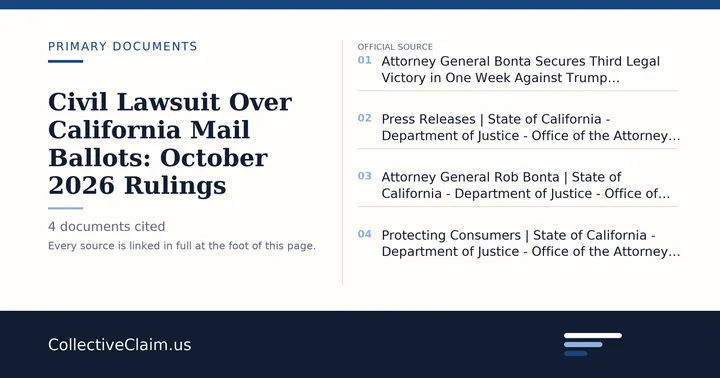
- California Department of Justice, Office of the Attorney General: “Attorney General Bonta Secures Third Legal Victory in One Week Against Trump Administration’s Attempt to Interfere in California Elections” (link, accessed 2026-11-24)
- California Department of Justice, Office of the Attorney General: “Press Releases” (link, accessed 2026-11-24)
- California Department of Justice, Office of the Attorney General: “Attorney General Rob Bonta” (link, accessed 2026-11-24)
- California Department of Justice, Office of the Attorney General: “Protecting Consumers” (link, accessed 2026-11-24)
CollectiveClaim.us publishes general legal information. This article is not legal advice and does not create an attorney–client relationship. Court records and agency actions change; verify current status with the court or agency before relying on it.
Advertisement
Advertisement